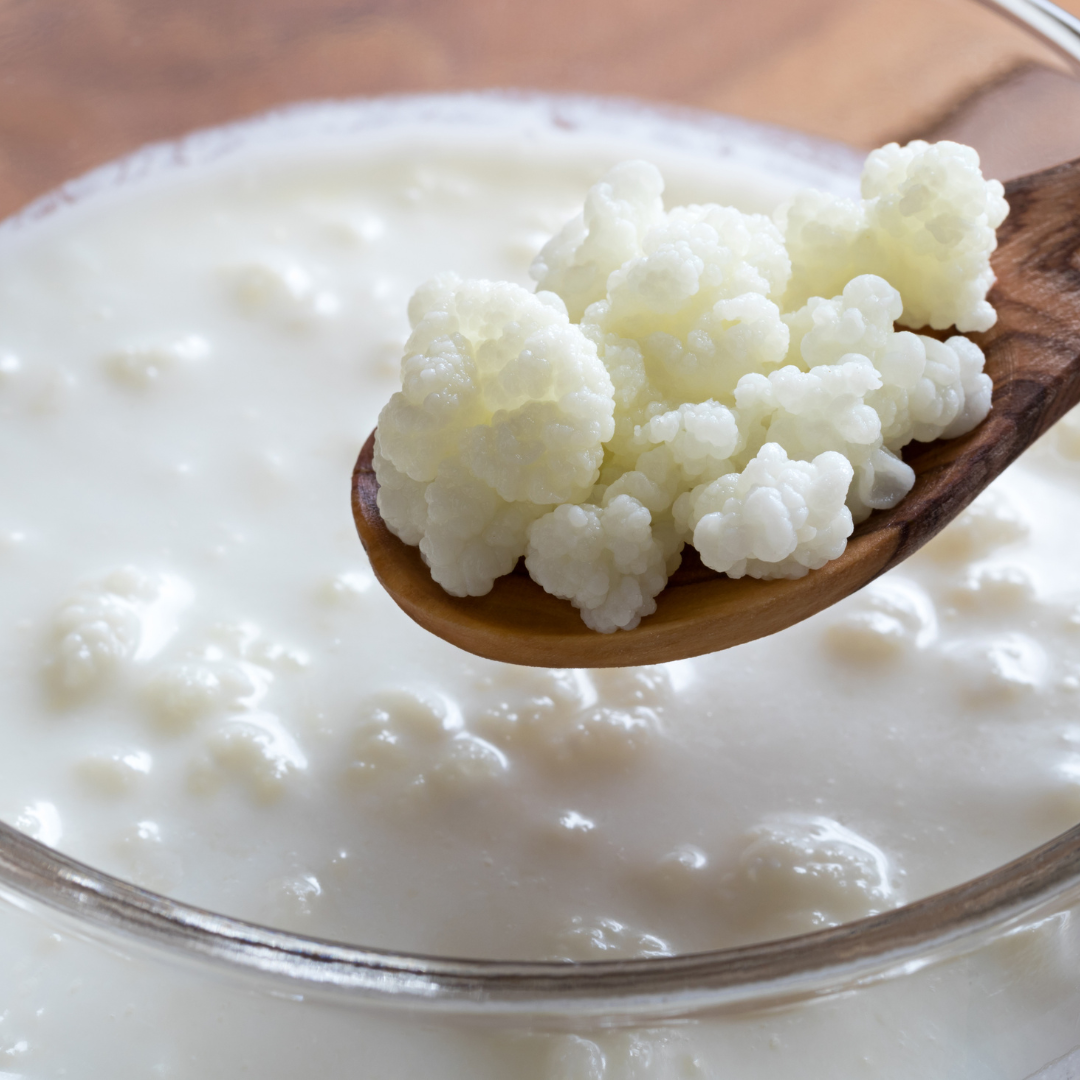
Kefir is an ancient fermented food that continues to gain popularity worldwide because of its reputed health benefits. As well as explaining how kefir is made and where it was first established, I take a look at the research that has been recently published.
So what is fermenting?
It’s as simple as this: it’s the
“transformative action of microbes”
You don’t have to understand the microbiology to get involved in fermentation; you may want just to see it as magic. Many people have produced fermented foods and drinks for 1000’s of years without understanding the microbiology.
A more comprehensive definition that I find useful is:
“ Fermented foods are defined as foods or beverages produced through controlled microbial growth and the conversion of food components through enzymatic action.”
How Kefir is made
Milk is fermented by unique Kefir grains, which consist of a polysaccharide matrix that has both bacteria and yeasts. This is also known as a SCOBY – Symbiotic Culture of Bacteria and Yeast. There are thought to be around 300 different strains of microbes from 15-40 families of microbes. There is far more diversity than in yogurt, for instance. These microbes will grow in the presence of fresh milk and convert the milk’s lactose into lactic acid. That is a very simplified description of one of the many pathways that occur during the fermentation process.
History
The story of where it comes from is perhaps one of my favourites. It is widely reputed that Kefir grains originated 2000+ years ago from the Caucasus mountains between Georgia and Russia. The legend goes that the grains were a gift from the Prophet Mohammed, and he had shown them how this “Magical elixir” would bring health and longevity – but only if it were kept a secret and definitely not shared with any strangers!!
Early in the 20th century, “The All-Russian Physicians’ Society” became interested in the Magic Kefir and was eager to get their hands on the grains. They deployed a young Russian woman named Irena Sakharova, who worked in a dairy. She was sent to charm the Caucasian Prince. He was very enamored by her, but the affection wasn’t reciprocated, particularly when he refused to give her the precious kefir grains!
Having failed to achieve her aim, she tried to leave. However, the prince had her kidnapped. She was rescued and he was arrested – then, to smooth things over, she was awarded the treasure she had been after
So by 1908, the Russians finally got hold of the kefir grains and distribution could begin. Those very same grains are thought to have produced the grains used all over the world.
Research
A quick look in PubMed for “ Kefir Health Benefits” shows that between 2025 and 2026 so far, there are 50 papers and 3 meta-analyses (reviews of reviews). Showing a pretty high level of interest. These are human studies on real people, not animals or petri dishes. However, the challenge is that we don’t just have the variability that comes with the human species, but equally, if not more varied, the composition of Kefir. Definitely a challenge for the researchers who enthusiastically go after the proof of “benefit.”
The 3 meta-analyses are very disappointing to read. They look at quite specific parameters; one (1) showed no significant difference to blood pressure or CRP ( a marker of inflammation). However did state trials longer than 8 weeks showed some benefit to CRP. Another (2) showed a reduction in fasting blood sugar, but no significant benefit to lipid levels or inflammation. Then one (3) looked at Kefir, yoghurt and Cheese and found no overall significant change to lipid levels.
A review of 28 clinical studies from Basel earlier this year (5) concluded Kefir intake showed potential benefits for gut microbiota modulation, metabolic parameters, inflammatory markers, immune function, and gastrointestinal health.
Whilst another review (4) included 16 studies and focused on oral health and stated “fermented-milk kefir may have potential as a complementary therapy in reducing oral Streptococcus mutans, thereby reducing dental caries risk. Also found evidence in Helicobacter pylori eradication therapy. Kefir may further aid treatment of adult dyslipidemia and hypertension, although evidence was very limited.”
Closing Thoughts
So you can see the list of potential benefits starts to expand as further research continues to verify this. It is, however, quite often the personal experience that will convince us of the benefits of fermented foods, as well as the fact that they are safe and tasty. If you like to be convinced more about Kefir, turn to UK expert Caroline Gilmartin and her personal experience.
https://everygoodthing.co.uk/blogs/news/my-kefir-story
There is so much more to know about Kefir. I hope this is enough to wet your appetite to find out more about fermented food, whether for personal consumption, an interest in biochemistry or a fascination with the evidence behind the legends. It’s a subject that keeps giving.
References
- Rashidbeygi E, Samarin MM, Sheikhhossein F, Khalilkhaneh AH, Gholizadeh M, Lohrasbi N, Abbasi A, Bazyar H, Askari G, Amini MR. The Effect of Kefir Consumption on Blood Pressure and C-Reactive Protein: A Systematic Review and Meta-Analysis of Randomised Controlled Trials. Endocrinol Diabetes Metab. 2025 Nov;8(6):e70124. doi: 10.1002/edm2.70124. PMID: 41139305; PMCID: PMC12554242.
- Hamsho M, Hawari R, Yeşil Z, Dakhel Z, Dursun Saydam D, Terzi M, Ranneh Y. Effect of different kefir dosages on inflammation status, metabolic profile, and anthropometric measurements in adults: A systematic review and meta-analysis. Nutr Metab Cardiovasc Dis. 2026 May;36(5):104364. doi: 10.1016/j.numecd.2025.104364. Epub 2025 Sep 11. PMID: 41076330.
- Yilmaz B, Alvanoudi P, Kalogeropoulou A, Santa D, Bulmuş-Tüccar T, Nikolaou A, Moreno-Indias I, Ruiz-Limon P, Gutiérrez-Repiso C, Hillesheim E, Meslier V, Mayo B, Malagon J, Chassard C, Praćer S, Vergeres G, Mantzouridou FT. Fermented dairy product consumption and blood lipid levels in healthy adults: a systematic review. Front Nutr. 2025 Sep 11;12:1651134. doi: 10.3389/fnut.2025.1651134. PMID: 41019545; PMCID: PMC12461264.
- Black EG, Bugarcic A, Lauche R, El-Omar E, El-Assaad F. The Effects of Kefir on the Human Oral and Gut Microbiome. Nutrients. 2025 Dec 11;17(24):3861. doi: 10.3390/nu17243861. PMID: 41470806; PMCID: PMC12735829.
- Fijan S, Povalej Bržan P, Šikić Pogačar M, Klanjšek P. Kefir Consumption and Health Effects Based on Human Clinical Trials: An Overview of Literature. Healthcare (Basel). 2026 Mar 4;14(5):652. doi: 10.3390/healthcare14050652. PMID: 41827605; PMCID: PMC12984562.
- Bodur M, Kocaadam-Bozkurt B, Bozkurt O, Aslan S, Ağagündüz D. Fermented foods and brain health: Gut-brain axis mechanisms and clinical insights. J Nutr Biochem. 2026 Mar;149:110195. doi: 10.1016/j.jnutbio.2025.110195. Epub 2025 Nov 24. PMID: 41297620.